

Have you built something new? Do you fear someone will copy it? Can you protect just a thought? Or do you need real code? Many founders ask these hard questions. They want to shield their work. But the law draws a clear line. You cannot patent a simple thought. You must show a real process. This guide shows you the path. Learn how to patent an app idea today.
But it isn’t as simple as filing a form. The law has rules. Some ideas qualify. But not all ideas match. We’ll show you exactly what counts, what it costs, and all the steps you should take in 2026.
Can You Really Patent an App Idea?
Let us discuss the difficult part. You can patent an app idea. You cannot patent a plain app idea. The law calls this an “abstract idea.” Think of something like “an app that connects buyers and sellers.” That is a concept. That concept is too broad to protect.
But you can patent how your app solves a problem. This is the key difference. Your app needs a specific technical method. Not just a business idea dressed up in code.
This rule came from a court case called Alice Corp. Back in 2014, the Supreme Court set a two-part test. First, your idea can’t be abstract on its own. Second, it needs something extra. Something inventive. A real technical solution, not ‘do this on a computer.’
So what do you think? Skip vague claims. Instead, describe your app’s actual method. Show the steps. Show the data flow. Show why it’s different from anything before it.
This is why how to patent an idea starts with clear documentation, not a rough pitch. Examiners want details. They want flowcharts. They want to see exactly how your system works, step by step.
Utility Patents vs. Design Patents
Apps can get two different kinds of patents. Each one tells something different. Here’s a full side-by-side breakdown:
|
Aspect |
Utility Patent |
Design Patent |
|
What it protects |
Functionality: algorithms, methods, system architecture, APIs |
Ornamental look: UI layouts, icons, transitions, screen designs |
|
Term |
20 years from the filing date |
15 years from grant date |
|
Total cost |
$5,000–$20,000+ |
$1,500–$3,000 |
|
Timeline to grant |
18–36 months |
12–24 months |
|
Maintenance fees |
Required at 3.5, 7.5, and 11.5 years |
None |
|
Best for |
Core technical innovations, unique backend logic |
Visual clones, UI/UX copying, distinct screen flows |
Many smart founders file both. One utility patent for the backend logic. One design patent for the front-end look. This combo covers more ground. It also makes copying your app much harder for competitors.
A fitness app is a good example. It might patent a real-time biometric feedback algorithm as a utility patent. Then it patents its dashboard layout separately as a design patent.
If your app has a truly unique visual style, don’t skip the design patent step. The USPTO made this route easier in 2026, with clearer drawing rules for screens and icons.
Step by Step: How to Patent Your App in 2026
Ready to start? Here’s the real process for patenting your app idea, broken into clear steps.
Step 1: Document everything.
Write down how your app works. Draw flowcharts. Map out your system architecture. Don’t just describe the idea. Describe the mechanism behind it. This step matters more than most people think.
Under 2026 USPTO rules, method claims need real flowcharts. Not rough sketches. Examiners expect:
- Black and white line art only.
- Standard shapes: rectangles for steps, diamonds for decisions, and ovals for start and end points.
- Reference numbers on every part, matching your written description.
- Files submitted through USPTO Patent Center, in PDF or DOCX format.
Step 2: Search for prior art.
Before you file anything, check whether your idea already exists. Use tools like Google Patents, the USPTO database, and Espacenet. Search using your keywords. If something close already exists, talk to a patent attorney before moving ahead.
Step 3: File a provisional patent application.
This is often the smartest first move when patenting your app idea. A provisional patent gives you a filing date. It also lets you use the phrase “patent pending.” You get 12 months to decide your next step. And it costs far less than a full patent.
Step 4: File your non-provisional application.
It is the real deal. It needs formal legal claims. It needs an oath from every inventor. It needs updated drawings that meet strict USPTO standards. This step is where most people hire a patent attorney, and for good reason. The claims you write here decide what you actually own.
Step 5: Respond to office actions.
After you file, an examiner reviews your application. They often push back with questions or rejections. This is normal. Don’t panic. Respond quickly and clearly, ideally with legal help. Most granted patents go through at least one round of this back-and-forth.
This complete process takes time. Expect 18 to 36 months from filing to grant for a standard utility patent. Design patents move faster, often within 12 to 24 months. Want it faster? Track One prioritized examination can cut this to 6 to 12 months, for an added fee.
2026 USPTO Costs: Full Fee Breakdown
Your total cost depends on your entity size. Most solo founders and small startups qualify for a discount.
|
Fee Type |
Micro Entity |
Small Entity |
Large Entity |
|
Provisional filing |
$65 |
$130 |
$325 |
|
Non-provisional utility (filing + search + exam) |
$400 |
$800 |
$2,000 |
|
Design patent (filing + search + exam) |
$220 |
$440 |
$1,100 |
|
Issue fee (on allowance) |
$258 |
$516 |
$1,290 |
|
Track One (fast-track exam) |
$933 |
$1,866 |
$4,665 |
Who counts as a micro entity? Your income has to be under about three times the median household income, roughly $230,000 in 2026. You also need four or fewer prior patent filings, with no licensing duty to a bigger company.
Who counts as a small entity? Businesses under 500 employees usually qualify, as long as they have no licensing ties to a large entity.
Filing as a micro entity cuts your USPTO fees by 75%. That said, attorney fees still make up most of your total bill. Expect $2,000 to $5,000 for a solid provisional draft and $7,000 to $18,000 or more for the full non-provisional filing.
Once your patent gets approved, you’re not done paying. The USPTO charges maintenance fees to keep it active. These come due at 3.5 years, 7.5 years, and 11.5 years after your patent is granted. Miss a payment, and your patent can expire early.
Alternatives to a Full Patent
If a full patent feels out of reach right now, you have other options. Here’s how they stack up:
|
Protection Type |
What It Covers |
Cost |
Speed |
Best For |
|
Copyright |
Source code, UI assets, content |
$45–$125 |
2–3 months |
Code clones, asset theft |
|
Trade secret |
Algorithms, data pipelines, internal tools |
$0 (with strong NDAs) |
Immediate |
Backend logic users never see |
|
Speed to market |
First mover edge, network effects |
$0 (execution cost only) |
Immediate |
Marketplaces, social apps |
|
Utility patent |
Functional methods, systems, processes |
$5,000–$20,000+ |
18–36 months |
Deep tech, defensible moats |
|
Design patent |
UI and UX look |
$1,500–$3,000 |
12–24 months |
Visual clones, layout copying |
Many founders combine a few of these. File a provisional patent. Register your copyright. Move fast. This combo gives you real protection without draining your budget.
Quick Decision Guide: How to Patent an Idea?
Not sure which path fits your app? Walk through this:
|
Your Situation |
Best Move |
|
Core value is a novel technical method, passes the Alice test, and you can fund $10k–$20k+ |
File a provisional, then convert to a full utility patent |
|
Novel technical method, but the budget is tight |
File a provisional only; rely on “patent pending” plus speed. |
|
Business idea, not a technical method, but UI is distinctive |
File a design patent |
|
Business idea: UI is not distinctive |
Copyright your code, launch fast |
Ask yourself four things before you file:
- Is my innovation technical, or just a business model?
- Can I explain it through flowcharts and diagrams?
- Do I have funds to enforce the patent later if someone copies it?
- Is my UI actually my biggest advantage?
What about AI-generated code?
One more thing worth knowing. If your app was partly built with AI tools, that’s fine. AI can’t be listed as an inventor, but a human still can be. As long as a person conceived the actual invention, your app stays eligible.
The USPTO updated its rules on this in late 2025. A human must meaningfully shape at least one claim. AI tools are not enough.
So write stable and clear code. Document everything before you submit. Because messy code slows your app. So that examiners can follow your logic.
Common Mistakes to Avoid
A few slip-ups trip up founders every year:
- Filing too late, after a public demo or launch starts, your 1-year clock.
- Writing a vague provisional that lacks real detail.
- Skipping the design patent and losing UI protection to a clone.
- Assuming AI-generated code can’t be patented, when it often can.
- Overestimating what a patent alone can do without funds to enforce it.
Your Next Move to Patent Your App Idea
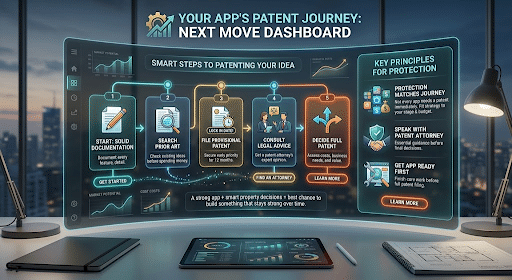
Patent your app idea the smart way. Start with solid documentation. Search for prior art before you spend a dollar. File a provisional application to lock in your date. Then decide, with real legal advice, whether a full patent makes sense for your business.
Not every app needs a patent right away. Before you do anything, speak with a patent attorney. If your app still requires work to be ready, get that done first. A strong app, supported by smart property decisions. It gives you the best chance of building something that stays strong over time.
Ready to Turn Your Vision Into a Market-Ready App?
Before you lock in your patent, ensure your app’s design, codebase, and architecture are rock-solid. At 5StarDesigners, we build scalable, high-performance apps that stand out in the market and meet the highest documentation standards.
Partner with 5StarDesigners Today. Let’s build an unbeatable app foundation to protect your IP!
FAQs
How much does it cost to patent an app in 2026?
A PPA costs $2,000 to $5,000 total. A full non-provisional patent costs $10,000 to $18,000. USPTO fees range from $65 to $325.
Can I patent an app idea without code?
Yes, you can file without working code. But you must describe your app in detail. Your docs must enable a skilled builder to create it.
How long does an app patent last?
Utility patents last twenty years from your filing date. Design patents last fifteen years from their grant date. Both require timely maintenance fee payments.
What is the difference between non‑provisional patents?
A provisional patent secures your filing date for one year. A non‑provisional patent begins the examination process. You must file the non‑provisional within one year of filing the provisional.
Can I patent an AI-generated app?
You can patent AI-assisted apps if humans conceived the claims. Pure AI output without human input cannot be patented. You must show your human role in the invention.